Paradoxes

In addition to many things on my active reading list right now, I’ve been reading the Tao Te Ching (Wayne Dyer’s translation of it at least). I’ve been having some great “ah-ha!” moments in realizing that not only is it okay to feel like there are imbalances in the world, that’s the way it works best! To be able to accept that the things that seem to be contradictory exist in the same space is as much a relief as it is disconcerting (ha! There’s one right now!) So much of my own frustration with transitions in life are that I feel pulled in many directions and not settled. This unsettled and stuck feeling can be an opportunity for more awareness to allow more movement.

One concept that helps to bring more awareness to patterns is the idea of your internal and external sensations. For example, I have a client who feels like she stands fairly straight and upright. When I had her look in the mirror, she was slouching forward significantly. How can that be? How can your internal sensations betray the external reality? Because they are both reality. They both exist at the same time, and both are true. Your internal subjective experience is YOUR reality.

So what can we do with this information? Well, as with anything we want to change, the first step is becoming aware of the thing you wish to change. If your internal sensations don’t match what the world sees, is that causing a problem? Could it cause a problem in the future? How does it feel for you to place your internal self into the external vision, and vice versa? When we worked to release and lengthen the front of her body, my client who had felt she was straight already but actually slouched forward felt as though she was going to fall over backwards! But then when she looked in the mirror, she was standing up very straight. Her body needed a little time to integrate this new pattern, and when she did, that is what felt “normal” to her. And in hindsight, she could remember feeling pulled forward with a depressed chest. Sometimes we don’t know we are out of balance until we come into balance, or even cross over to the opposite side. This particular conflict led to awareness, then call to action, change, and ultimately more freedom of movement because she found greater balance. Even though her initial posture wasn’t causing significant pain, this new found alignment offered her more flexibility and more freedom.

We are adaptive creatures, yet we can become stuck and complacent in our patterns and it can be disconcerting when we are challenged with change. Know that life is change, and part of a somatic practice is being comforted by the constant movement of life, even when that movement feels so still at times.

As soon as beauty is known by the world as beautiful, it becomes ugly.
As soon as virtue is being known as something good, it becomes evil.
Therefore being and non-being give birth to each other.
Difficult and easy accomplish each other.
Long and short form each other.
High and low distinguish each other.
Sound and tone harmonize each other.
Before and after follow each other as a sequence.

~ From the second verse of Lao-tzu’s Tao Te Ching

Gaining Height with Somatics?

I’ve had clients tell me they gained inches in height after working with somatic explorations. Blows the whole “we shrink as we age” thing out of the water, I think! In addition to the explanation in this link below, there is also Thomas Hanna’s description of a “dark vise”. That is the imbalance between our natural green light and red light responses in the front and back of the body. Years of emotional stress can pull us forward, impeding our breath, depressing our shoulders and chests, rounding the spine forward. On the other side, we are constantly being called to action, moving forward, tightening our back in green light (or Landau) response. The body likes to be in balance against gravity, so if we are too pulled back or too far forward, the other side says “whoa whoa whoa!! I don’t want to fall over!”, and so contracts to pull the body back. This can cause significant pain from overuse in both sides of the body. If each side of the body, front and back, keeps arguing over which one needs to pull upright out of gravity, this can create compression of the spine, leading to shortening of the muscles between vertebrae, “shrinking” the body in height. Now, there are conditions that actually do deteriorate the connective tissue between the vertebrae, but I think we have ignored a very important piece by dismissing the muscles and function of the center of our body.

Continue reading Colm McDonnnell’s easy anatomical description here.

Upcoming Events!

I have 2 workshops coming up in the next few weeks –
A FREE introduction to me and Somatics:
Wednesday, July 15, 6-7pm
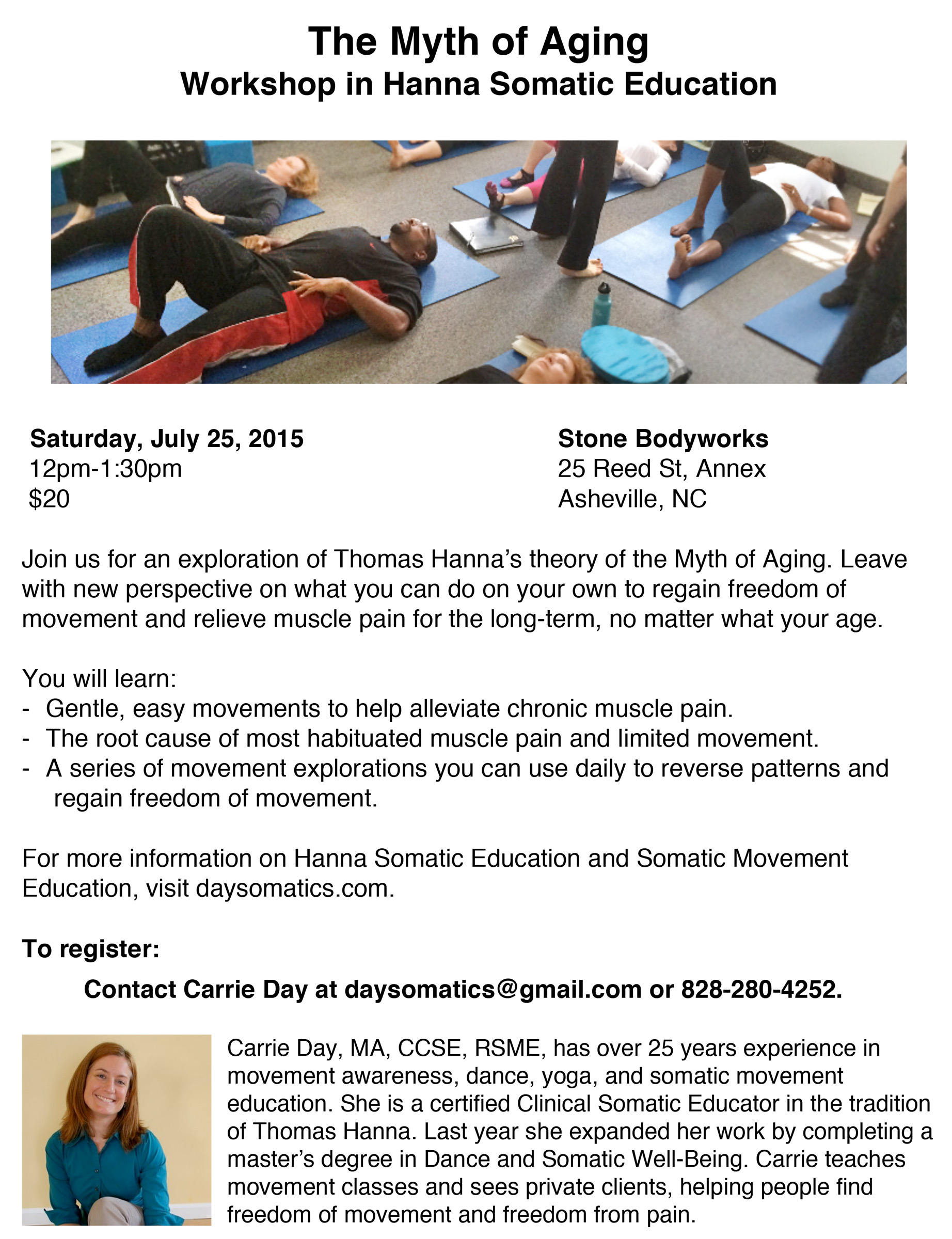
And “The Myth of Aging Basics”, $20
Saturday, July 25, 12pm-1:30
Both classes will be held at Stone Bodyworks in Asheville.

Please register with me by email or phone:
daysomatics@gmail.com
828-280-4252

Hope to see you there!

Intro talk flyer 2015 MoA class template


Myths about Hip Pain

I have been seeing a few clients recently who have been told they needed a hip replacement. According to WebMD, the number of hip replacement procedures that have been performed in the US has doubled in the last ten years. The reason, doctors say, is an increase in osteoarthritis. And patients are getting younger and younger.

Martha Peterson recently posted “The Top 3 Myths About Hip Pain”, which are very helpful in helping our clients avoid possibly unnecessary surgery.

Myth Number 1: “You Hip Pain is due to arthritis” Sometimes it is, sometimes it isn’t. Many clients tell me their doctors have said “it’s just apart of aging”. I find that hard to believe in otherwise healthy people under the age of 50. I find it hard to believe in otherwise healthy people of any age, actually. I do find that doctors are quick to dismiss pain as result of “aging”, but how can any condition be the result of simply getting older?

Myth Number 2: “Your hips are weak” If muscles are tight, they are habitually contracted. Habitually contracted muscles are already working too hard. Muscles that are working too hard are not weak, they cannot be released to be weak and unusable. Hanna Somatics helps to identify this habituated over-contraction, and helps clients to regain control over the full length of the muscles, not just the part that has been contracting.

Myth Number 3: “Surgery is the only option for hip pain” Although good intentioned, oftentimes doctors are looking at a problem to fix, rather than look at the bigger patterns that may have contributed to hip pain in the first place. Although habituated muscle function can lead to structural damage, I witness many people who are just not there yet. They still have time to deconstruct patterns in the body, correct, and improve movement in the hip joints and center of the body.

I also find that clients start to “protect” their hips by not moving them very much, leading to greater immobility and tighter joints in the center of the body as well as the hips. Then it is a case of the muscles of the center working harder and doing extra jobs, potentially leading to more pain. Once the center of the body is released, the brain can trust fuller movement again, and hip pain is relieved.

For Martha’s full article, and a great video on releasing the center of the body, click here.

Welcome!

Clinical Somatic Education, also known as Hanna Somatic Education, is a gentle, safe, and highly effective way to end chronic pain, increase balance and flexibility, and relieve day to day stress. Through intelligent movement, we can enjoy a pain free body.

Welcome to DaySomatics.com. Learn more about Clinical Somatic Education, find class information, and links to other Somatics practitioners.

You can email me at daysomatics@gmail.com with questions or comments.